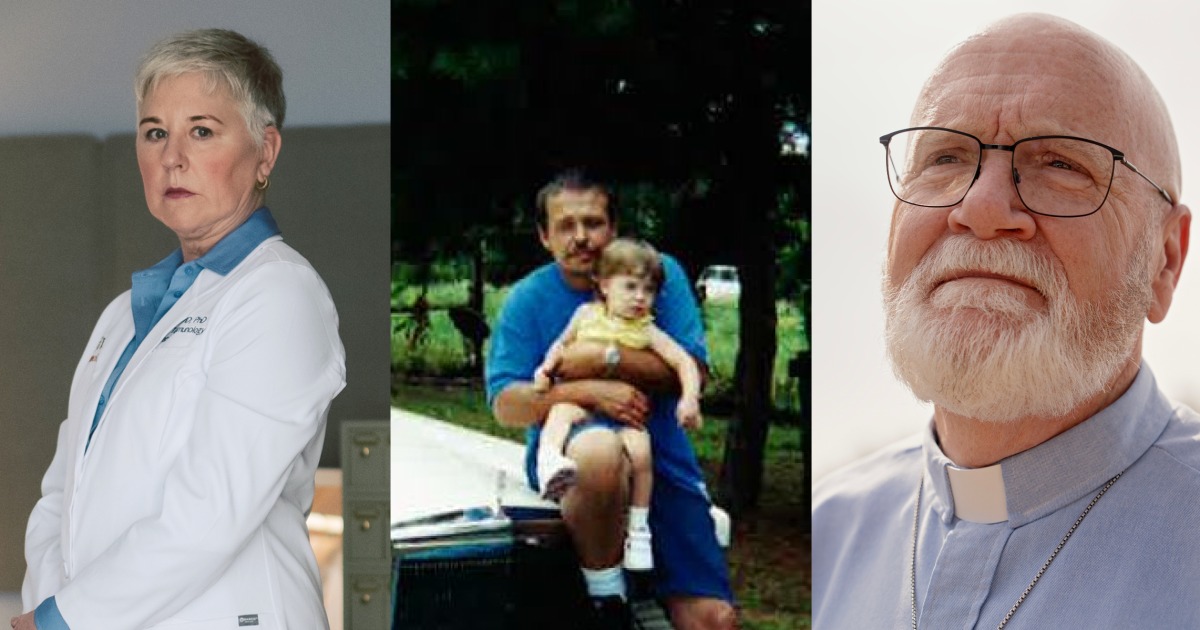
Around 2014, he said, his understanding of shaken baby syndrome began to change, as more and more medical professionals who had once supported the science came out. openly criticized itA leading voice was pediatric neurosurgeon Dr, Norman Guthkelch, who in 1971 wrote a paper Proposing a theory that shaking young children could cause bleeding in the brain.
one in Court announcement in 2012 Related to the case of a shaken baby in Arizona, Guthkelch expressed concern over how prosecutors were applying his hypothesis to infer abuse: “I recognize that this is a distortion of the article I wrote in 1971, resulting in that article being taken as supporting a diagnosis of criminal liability in circumstances I never envisioned.”
Until his death in 2016, Guthkelch continued to speak out about misinterpretations of his research.
Turner challenged her thinking in late 2017, when she was working at a general hospital in Canada. He said he was asked to review the case of a 5-week-old boy who was born with health complications. Other medical professionals saw signs of abuse that implied shaken baby syndrome, she said, but despite feeling “pressure” to join them, she was not convinced.
Turner said, “I am forced to consider murder.” But “sometimes, you can’t really tell.”
American Academy of Pediatrics And other associations representing child abuse pediatricians – doctors who specialize in evaluating potential abuse or neglect – defend the diagnosis of shaken child. In 2009, the academy said it was adopting a broader term, “abusive head trauma”, to better explain how other abusive actions beyond shaking can cause head injury. The Academy emphasizes that the child’s health history should be thoroughly evaluated and a team of experienced professionals should work together to make complex determinations.
In recent years, Turner, who now runs her own medical and legal consulting firm, has continued to provide second opinions to prosecutors in child abuse cases. But she also serves as an expert witness for the defense when parents face criminal charges.
“I hope I get the opportunity to right the wrongs,” he said.
‘I forgive them’
A pair of medical examiners changed Xavion Johnson’s fate twice — once when their testimony convinced a jury that he bludgeoned his daughter to death and again more than a decade later, when they reversed themselves and helped free him.

Johnson, a first-time father in 2001, was 18 when he was babysitting his 4-month-old daughter, Nadia, in their Sacramento, California home while the girl’s mother was at work. He said he picked up the baby while they were bathing together in the shower, but she slipped out of his hand and hit her head on the back of the tub.
He didn’t see any bleeding or lump, he said. Hours later, when she stopped breathing, she dialed 911. At the hospital, doctors noted severe head injuries and suspected abuse. The police were called.
After two days the girl’s condition deteriorated. Johnson was holding Nadia when doctors took her off life support. On the day of her funeral, police arrested Johnson on charges of murder and assault.
At her 2002 trial, prosecutors relied on the testimony of three medical experts, including Dr. Gregory Reber, a forensic pathologist, and Dr. Claudia Greco, a neuropathologist, to argue that Nadia died from shaking and deliberate impact.
Reber, who performed Nadia’s autopsy, testified that the hemorrhages behind her eyes were associated with shaken baby syndrome and indicated “a severe shock had occurred.” Greco testified that the injury to the girl’s cervical spine was the “most convincing evidence” of shaken baby syndrome and that the fall as Johnson described could not have caused that much damage.
Johnson was convicted and sentenced to 25 years to life in prison. More than a decade later, the Northern California Innocence Project helped locate the original medical experts and asked if they would review her case again. Reber and Greco agreed, and the two arrived at a new discovery in early 2017.
“The current re-evaluation has led me to the conclusion that accidental injury cannot be ruled out,” Reber wrote in an affidavit recanting his testimony.
Greco wrote in her affidavit that the spinal cord injury she believed to be important in pointing to shaken baby syndrome “has not been well studied” and that her decision was based on a medical consensus in 2002.
A Sacramento County Superior Court judge vacated Johnson’s conviction, and in early 2018 prosecutors declined to retry him. He was freed after serving 16 years of his sentence.

Johnson recently said of medical experts, “It takes a lot of courage to say they were wrong.”
Neither Reber nor Greco could be reached for comment.
Johnson, now 42 and the father of another young daughter, says he feels let down by the justice system when he hears that other parents who claim innocence are still accused of similar things.
He’s doing what he can to change that. Shortly after his release, he said, he was asked to speak to law enforcement officials and lawyers at a conference in the Bay Area about misleading evidence and false science. Reber was also in the room, he said. Johnson recalled that they later shook hands with tears in their eyes.
“I forgive them,” he said of those whose testimony put him behind bars. “My faith allowed me to overcome the hatred, anger and despair that I had suffered up to that time.”
search for freedom
Others who maintain their innocence may be closer than ever to their goals of freedom.
In New Jersey, according to the State Office of Public Defender, the State Supreme Court’s decision that expert testimony regarding shaken baby syndrome is scientifically unreliable could lead to an untold number of criminal as well as family court cases.
One caregiver who may benefit is Michelle Heil, who was sentenced in 2015 to 15 years in prison for aggravated murder and child endangerment.

Heil was babysitting her friends’ 14-month-old son, Mason Hayes, at her Toms River home in 2012 when, she said, the boy began choking on applesauce. She said he hit her on the back to dislodge the food and as her head slipped back, she went limp. He was taken to hospital and died four days later.
Doctors suspected that Mason was shaken, and Monmouth County prosecutors at Heil’s trial said that his version of events was inconsistent. At the time, Heal, the mother of young twins, denied that he had abused her.
“Shaken Baby Syndrome is a flawed theory that has divided the medical community for many years but has also divided family and friends,” Heil said while sentencing him“This needs to stop,”
Mason’s parents, Adam and Kelly Hayes, supported Heil’s sentencing. He declined to comment.
Heil’s lawyers are trying to overturn his conviction and have filed a brief based on the state judiciary’s conclusion that the baby science is unreliable.
The Monmouth County Prosecutor’s Office declined to comment on the specifics of the case, but said in a statement that it believes the state Supreme Court’s decision has “no legal implications” for Heil’s conviction, despite prosecutors arguing that it is based on other evidence that could withstand any further challenges.
As both sides await the judge’s decision, this historic decision is already having ramifications beyond New Jersey.