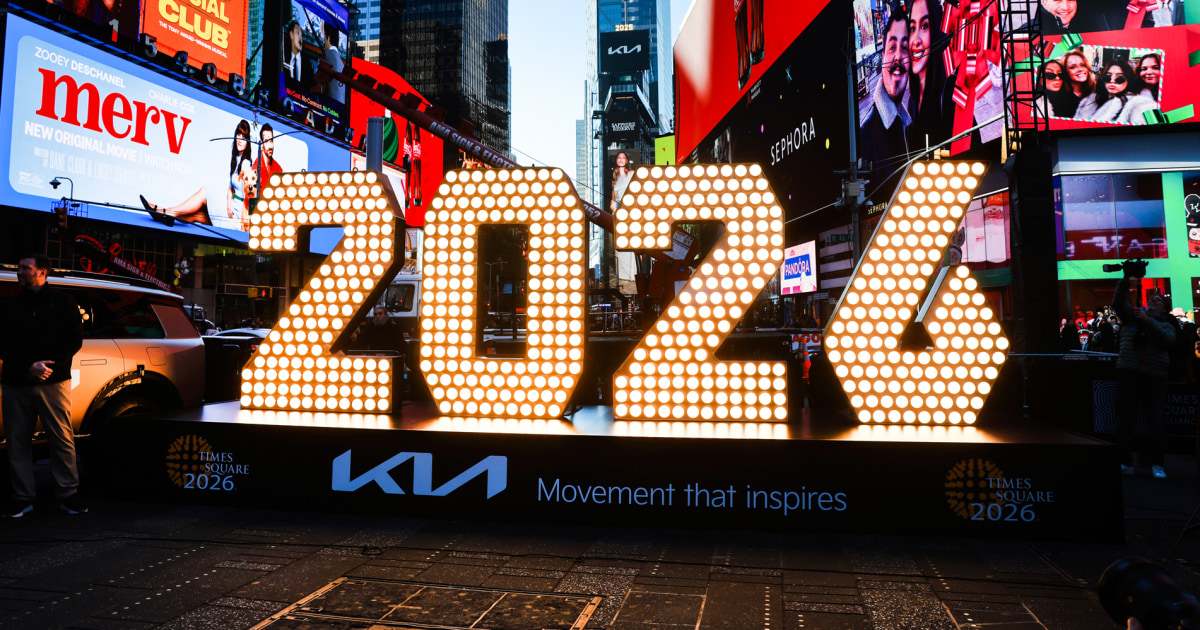
It’s that time – the waning days of December, when we prepare to turn the pages of the calendar. Many Americans take stock, reviewing goals accomplished and unfulfilled, reflecting on hopes and plans. How is our health? What is the condition of our money? What about the country? Will the year ahead look similar to the year gone, or be completely different?
Are we ready?
This can be an overwhelming period. So The Associated Press contacted professionals with varying expertise — home organization, risk management, personal training, personal finance and political science — to talk about the changes and their perspectives on the changes.
And for something a little different, we gave each interviewee a chance to ask the other a question.
So let’s talk about endings and beginnings.
Change expert: Milestones provoke emotions
Transitions is professional organizer Laura Olivares’ work life. As co-founder of Silver Solutions, she works with senior adults and their families to help ensure they are in a safe environment, whether that means clearing out lifetime possessions, downsizing to another home, or helping families declutter after a loved one passes away.
She offers this: Change, even exciting ones, can elicit sadness or grief over the places, things, and people left behind. Acknowledging those feelings can make it easier to move from one chapter to the next.

“When you let go of something that was meaningful to you, it deserves a moment,” she says. “Whatever that moment is, it could be a second, just an acknowledgment of it. Or maybe you set it on the mantle and you think about it for a while and when you’re ready to let it go, you let it go.”
Certified personal trainer Kerry Harvey asked: “What small weekly habits can I create that will help me stay organized during the year?”
Olivares’ tips: In December, take a brain dump of ideas, thoughts and goals. Then, before January 1, schedule actions that advance those priorities through 2026. Olivares suggests three tasks every three days, so nine tasks per week.
Actuaries: Planning is important – but sometimes also untenable
Probably no group of people thinks more about the future than actuaries. Using data, statistics, and probabilities, they model how likely certain events are to occur, and how much it might cost to recover from them. Their work is important for organizations such as insurance companies.
However, R. Listen to Dale Hall talk, and he sounds almost… philosophical. He is the Managing Director of Research at the Society of Actuaries. When asked how the general public can approach the new year, he quickly brings up strategies like figuring out risk scenarios and how to respond.
There has to be a balance, he says: We can’t control or predict everything and we have to accept the possibility of something unexpected. And the past is not always a perfect guide; Just because something happened doesn’t mean it should happen again.
“That’s the nature of risk-taking, isn’t it? Yes, things are going to get out of control,” says Hall. “Maybe there are ways to diversify those risks or mitigate those risks, but no one has that ideal crystal ball that’s going to look three, six, nine, 12 months into the future.”
From personal finance teacher Dana Miranda: “Thinking about the variables we consider when making decisions or plans, how might comparing the holiday season with the New Year affect the way people evaluate their finances and set goals at the beginning of each year? … What do you recommend to ensure that the holiday experience does not impact financial goal-setting?”
Hall’s advice: Keep them separate. He suggests that people enjoy the holidays and postpone financial goals until January.

Personal Finance Authority: Be Intentional About Money
In her work as a financial writer and personal finance teacher, Miranda encourages people to make conscious choices about their spending and saving, and understand that there are no absolute rules.
Miranda, author of “You Don’t Need a Budget,” says the details are important. What works for one person may not work for another. And it’s something Americans should consider as we approach another year of goals and resolutions. Miranda says that insisting that the same technique works for everyone can make people feel stuck.
“We’re not good at talking about specifics and that leads people to think, ‘This is the perfect rule. It’s not possible for me to achieve that perfection, so I’ll feel embarrassed at every step I take that isn’t moving toward that perfect goal.'”
Political science professor Jean Theoharis asked how Miranda inspires people to look beyond the micro and consider the larger system of capitalism. “How does she get people to think about more collective solutions — like union organizing, pressuring city council or Congress for change?”
Miranda is quick to make it clear that she’s not an organizer, but says she tries to raise larger systemic issues when discussing personal finance. “The way I try to move that needle a little bit is to always bring that political aspect into whatever conversation we’re having… to show the systemic and cultural impacts.”
Coach: Make Goals Attainable
When it comes to changes and the New Year, one of the most popular areas is fitness, the subject of many (unsuccessful) resolutions. Personal trainer Harvey, of Form Fitness Brooklyn, says you can make positive, lasting changes in fitness (and in general) with one philosophy: Start small and build up.
“We want to be conscious of making sure that we’re not demanding too much or trying to compensate too much for what we left behind last year or what we feel we left on the table,” she says. “It’s much wiser to try to go to the gym twice a week, maybe three times a week and then move on from there rather than saying ‘January 1, I’m starting, I’ll go to the gym five days a week, two hours a day.’ That’s not realistic and it’s not kind to us.”
“What advice do you have for me on how to transition into a more robust workout schedule in 2026 without risking injuring myself by doing things too quickly?” Hall asked.
Harvey emphasized warm-up and movement routines, and made the goal achievable by making it fun. “Find things that you really enjoy doing and try to fit those in too so that the idea of starting something new or adding to it isn’t one that comes with a negativity of, ‘Oh, I don’t want to do this,’ where you’re dragging yourself into it.”

Historians: Learn from your past
We don’t think about change only as individuals. Nations and cultures also have these.
If we look at our histories honestly and not under the guise of trying to hide the ugly parts, we can learn from them, says Theoharis, a professor of political science and history at Brooklyn College and the City University of New York Graduate Center.
She points to the story of Rosa Parks, who is remembered as the catalyst for the Montgomery bus boycott 70 years ago. But when Parks decided to protest, she had no idea what her arrest would mean or what the consequences would be. Theoharis sees a lesson there for people seeking change and even growth in today’s world.
“Many of us would be willing to do something brave if we knew it would work,” says Theoharis. “And we may even be willing to suffer some consequences. But looking at the real history of Rosa Parks or the real history of the Montgomery bus boycott shows that really you have to make these stands without any sense that they will work.”
Olivares wanted to hear Theoharis’s thoughts on today’s civil rights fight. Theoharis referenced voting rights, which have been eroded in recent years. At the same time, memories of the upheaval during the civil rights years have been blurred by a mythology of America overcoming its injustices.
There’s a lesson there about what it takes for individuals to make real change, Theoharis says: It’s hard to move forward if you’re not honestly addressing what’s come before. “Part of how we got here is… a lack of reckoning with ourselves, a lack of reckoning with where we are, a lack of reckoning with history.”